
Finding the right mental health support for a child can be difficult, especially for Iranian families living abroad. Parents searching for a Farsi child psychologist online often want a professional who can understand not only their child’s emotional needs but also their language, family environment, cultural background, and experience of growing up between two cultures.
A child may speak English or another language comfortably at school but still find it easier to talk about emotions, family relationships, fears, or personal experiences in Farsi. Parents may also feel more comfortable discussing sensitive concerns in their native language.
For families who cannot easily access Persian-speaking mental health professionals where they live, online consultation can provide another way to explore their child’s needs and determine what type of professional support may be appropriate.
What Does Farsi Child Therapy Online Mean?
Farsi child therapy online refers to mental health support provided remotely to Persian-speaking children, teenagers, and their families.
Depending on the child’s age, concerns, and the qualifications of the clinician, online care may include an initial assessment, psychotherapy, parent consultation, behavioral guidance, or referral for additional evaluation.
It is important for parents to understand that psychologist, psychiatrist, and therapist are different professional roles. If you are unsure which type of specialist your child needs, our guide to the difference between a psychologist, therapist, and psychiatrist can help clarify these differences.
The goal should not simply be to find someone who speaks Farsi. The clinician’s professional background and experience with the child’s specific concerns are equally important.
Looking for professional online therapy in Farsi for your child?
Dr. Saeed Ansari provides online psychiatric and psychotherapy services for Persian-speaking families worldwide. Book your consultation today and receive expert support from the comfort of your home.
When Might a Child Need Mental Health Support?
Changes in mood and behavior can occur naturally during childhood and adolescence. However, professional assessment may be helpful when these changes persist, become more intense, or begin interfering with everyday life.
Parents may consider seeking professional guidance if they notice:
- Persistent anxiety or excessive worrying
- Frequent sadness or irritability
- Withdrawal from friends or activities
- Significant changes in sleeping or eating habits
- Repeated anger or emotional outbursts
- Difficulty concentrating
- A noticeable decline in school performance
- Problems adjusting after immigration
- Difficulty making friends in a new country
- Low self-esteem
- Persistent family conflict
- Behavioral changes following separation, loss, or another major life event
Experiencing one of these signs does not necessarily mean that a child has a mental health disorder. The child’s age, development, environment, duration of symptoms, and family circumstances should all be considered.
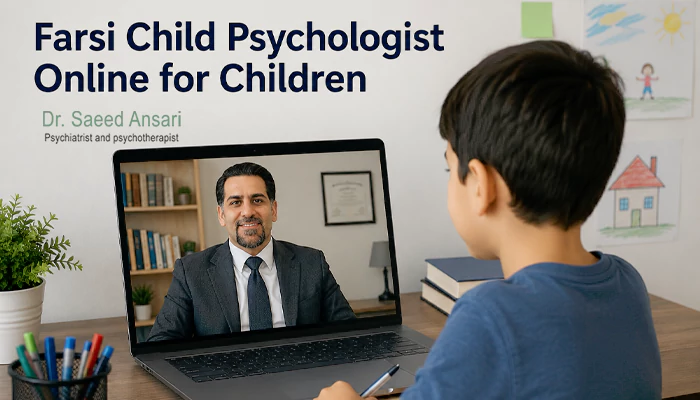
Online Farsi Therapy for Children After Immigration
Immigration can affect children differently.
Some adapt quickly to a new language, school, and social environment, while others may struggle with loneliness, cultural differences, separation from relatives, difficulty making friends, or uncertainty about where they belong.
Mental health challenges related to migration are not limited to children. Parents may also experience emotional pressure, homesickness, relationship stress, and difficulty adapting to a new environment. Our article on Iranian mental health for immigrants explores these challenges in more detail.
Children growing up abroad may also experience a gap between the culture they encounter at school and the expectations they experience at home.
For example, a child may feel comfortable speaking English during everyday activities but prefer Farsi when describing an emotional experience involving parents, grandparents, or Iranian family traditions.
In these situations, receiving support in a familiar language may make communication easier.
Why Does Language Matter in Child Therapy?
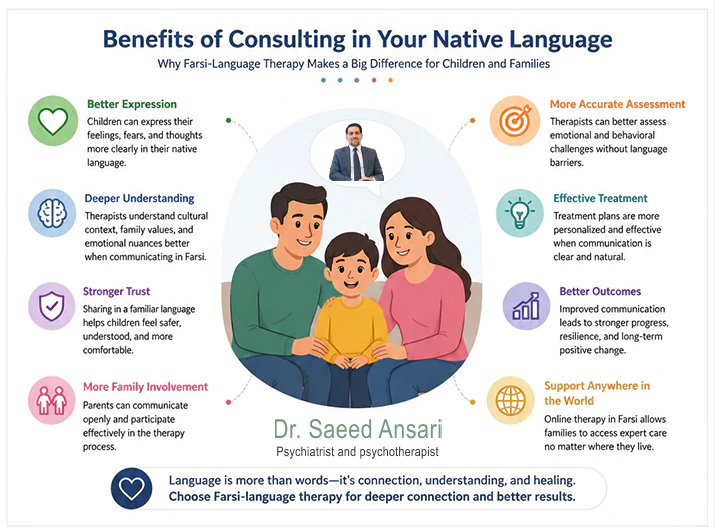
Mental health conversations often involve emotions that are difficult to describe even in a person’s native language.
For bilingual children, translating those feelings into another language can sometimes add another layer of difficulty.
This is one reason some Iranian families prefer Farsi therapy online, particularly when discussing topics connected to childhood, parenting, family relationships, immigration, or cultural identity.
A Persian-speaking clinician may also understand cultural references and family dynamics without requiring the child or parents to explain every detail.
However, speaking the same language does not automatically make someone the right therapist for a child. Clinical qualifications, experience, and the suitability of online treatment still need to be considered.
How Does Online Child Therapy Work?
Online mental health care for a child should be adapted to their age and developmental level. It is not simply an adult therapy session conducted with a younger person.
The process may include several stages.
1. Initial Discussion With Parents
Parents can explain what they have noticed, when the problem started, how the child behaves at home and school, and whether any major changes have recently occurred.
The clinician may also ask about previous treatment, physical health, medications, family circumstances, and school performance.
2. Talking With the Child
Depending on age and circumstances, the clinician may speak directly with the child or teenager.
Older children may be able to participate independently for part of the session, while younger children often require more parent involvement.
3. Understanding the Main Concern
The purpose of the initial consultation is to develop a clearer picture of the problem.
Not every child who attends an online consultation requires ongoing psychotherapy.
Recommendations may include:
- Follow-up sessions
- Parent guidance
- Psychological assessment
- Family-based support
- Monitoring symptoms
- Referral to a child specialist
- In-person evaluation when necessary
4. Follow-Up
If online treatment is considered appropriate, future sessions can be planned according to the child’s individual needs and treatment goals.
If you are searching for a trusted Farsi-speaking therapist for your child, schedule an online consultation with Dr. Saeed Ansari and receive professional guidance tailored to your family’s needs.
What Role Do Parents Have in Child Therapy?
Parents generally have a more active role in child mental health care than they would in therapy for an adult.
This does not necessarily mean that parents need to attend every minute of every session.
Their involvement may depend on:
- The child’s age
- The main emotional or behavioral concern
- The treatment approach
- Family circumstances
- The child’s ability to communicate independently
Parents may be asked to observe behavior at home, make changes to routines, use different communication strategies, or attend separate sessions.
At the same time, older children and teenagers may need an appropriate level of privacy to feel comfortable discussing their emotions.
Family Relationships and a Child’s Emotional Health
A child’s emotional difficulties do not always exist separately from the family environment.
Immigration stress, disagreements between parents, different approaches to parenting, financial pressure, or major changes within the family can all influence how a child feels and behaves.
Sometimes supporting the parents or improving communication within the family is an important part of helping the child.
For Iranian couples living abroad who are experiencing persistent relationship difficulties, Persian couples therapy online may also be relevant when marital stress is affecting the wider family environment.
This does not mean that every behavioral problem in a child is caused by parents. It simply means that assessing the wider family situation can be important.
What Ages Are Suitable for Online Child Therapy?
There is no single age at which online therapy becomes appropriate for every child.
A teenager who is comfortable communicating through video may engage effectively in an online consultation, while a younger child may find it difficult to remain focused.
Before recommending online care, factors such as these may need to be considered:
- Age and developmental level
- Attention and concentration
- Ability to communicate online
- Type of symptoms
- Severity of the problem
- Need for parental involvement
- Privacy at home
- Need for play-based or in-person assessment
For some children, an online consultation may be useful even if subsequent treatment needs to be provided locally.
When May Online Therapy Not Be the Right Choice?
Online therapy is not appropriate for every child or every situation.
An in-person or urgent local assessment may be more appropriate when:
- Symptoms are severe or rapidly worsening
- There are immediate safety concerns
- The child cannot participate effectively online
- A detailed in-person assessment is required
- The child requires services that cannot reasonably be provided remotely
Parents should also know what to do and who to contact locally if an urgent mental health situation occurs.
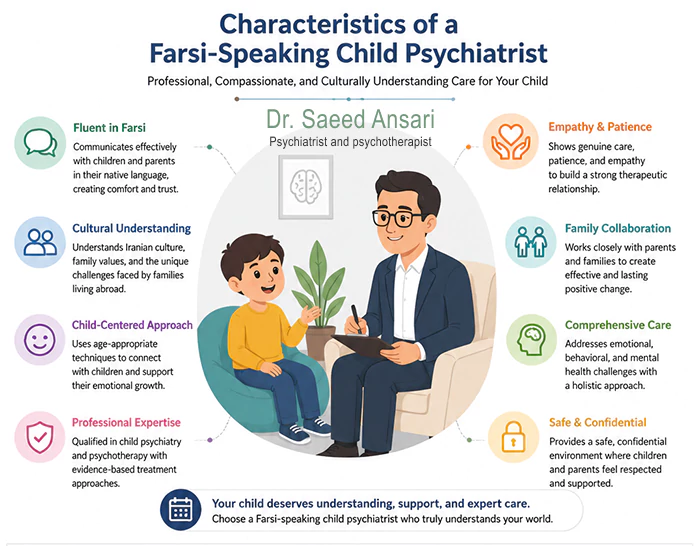
How to Choose a Farsi-Speaking Mental Health Professional for Your Child
When looking for professional support, avoid making a decision based only on phrases such as Farsi child psychologist online or “Persian therapist near me.”
Instead, consider:
- Professional qualifications
- Experience with children or adolescents
- Experience with the specific problem
- Approach to parent involvement
- Treatment method
- Privacy and confidentiality
- Availability of referrals when needed
- Suitability of online treatment
Parents searching more generally for Persian-language mental health services can also read our guide to finding an online Persian psychologist for Persian speakers abroad.
Choosing the appropriate professional is more important than simply finding someone who speaks the same language.
Online Child Therapy With Dr. Saeed Ansari
Dr. Saeed Ansari is a psychiatrist and psychotherapist providing Persian-language mental health services.
For parents who are concerned about their child or teenager, the first step is determining what type of evaluation or mental health professional is appropriate for the situation.
Depending on the child’s age, symptoms, location, and individual needs, an initial consultation may help clarify whether further psychological support, psychiatric assessment, parent guidance, or referral to a child and adolescent specialist should be considered.
Need Guidance About Your Child’s Mental Health?
If you are a Persian-speaking parent living abroad and are unsure what kind of support your child needs, you can contact Dr. Saeed Ansari to ask whether an online consultation is suitable for your situation.
The purpose of seeking help is not simply to give a child a diagnosis. It is to better understand what they are experiencing and determine the most appropriate next step.